
Track and Field Training for Year-Round Dominance
For the dedicated parent of a competitive track and field athlete, the goal is simple: you want to see your athlete succeed.
You want them to accelerate faster out of the blocks, reach higher top-end speeds, jump farther or higher, generate explosive power in throwing events, and maintain their strength and performance when it matters most. You want them to stay healthy, compete with confidence, and perform at their best from the first meet of the season through championship competition. While sprinting technique, race strategy, jumping mechanics, throwing technique, pacing, and event-specific skills are essential, they are only part of what it takes to perform at a high level.
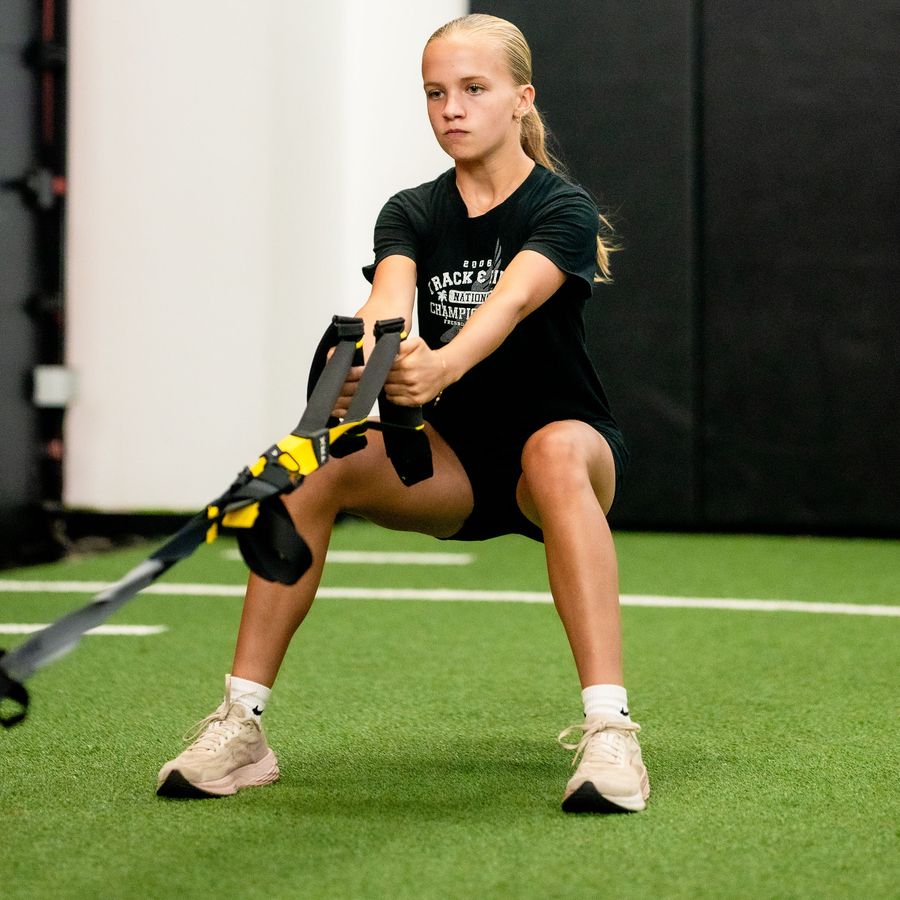
Athletic Republic's science-based performance training develops the physical tools that help athletes turn their track and field skills into competitive performance. Our programs are designed to improve explosive acceleration, maximum speed, lower-body power, full-body strength, mobility, stability, and conditioning, helping track and field athletes become faster, stronger, more explosive, and more resilient competitors who can make an impact in their chosen events, whether sprinting down the straightaway, powering through the final lap, launching into a jump, or generating explosive force in the throwing circle.
Here is a breakdown of the game-changing benefits your athlete will gain through our specialized track and field training protocols:
Explosive Speed and Acceleration
Track and field is a sport where fractions of a second can determine the difference between winning a race, setting a personal record, or falling short of a qualifying time. We develop the explosive lower-body strength, first-step quickness, and acceleration athletes need to drive powerfully out of the starting blocks, build speed efficiently, and reach higher velocities. By improving an athlete's ability to generate force quickly, our training helps build the physical foundation for faster starts, stronger acceleration, and improved sprint performance.
Maximum Speed and Speed Endurance
Track athletes need more than explosive starts. Sprinters must develop the ability to reach and maintain high speeds, while middle-distance runners need to sustain efficient, powerful movement as fatigue builds. Our training develops the strength, coordination, neuromuscular efficiency, and conditioning that support faster running speeds and the ability to maintain quality movement throughout a race. These physical qualities help athletes build the foundation for stronger finishes, improved race performance, and more consistent results throughout the competitive season.
Explosive Power and Full-Body Strength
We develop lower-body strength, explosive power, and coordinated force production that support performance across track and field events. By strengthening the hips, legs, core, shoulders, and upper body, our training helps athletes build the physical foundation for more powerful sprint strides, explosive jumping takeoffs, and greater force production in throwing events. Developing full-body strength and power helps athletes generate force efficiently, whether accelerating down the track, launching into a jump, or producing explosive movements in the throwing circle.
Improved Movement Mechanics and Efficiency
Track and field performance depends on more than simply running fast, jumping high, or generating maximum force. Athletes must develop efficient movement patterns, proper body control, coordination, and the ability to apply force effectively. Our training develops sprint mechanics, posture, hip stability, joint mobility, balance, and neuromuscular coordination, helping athletes build the physical foundation for more efficient acceleration, powerful takeoffs, controlled landings, and consistent movement throughout their events.
Increased Durability and Injury Resistance
Track and field places significant physical demands on the hamstrings, calves, hips, knees, ankles, shoulders, and core through repeated sprinting, jumping, throwing, and high-volume training. We develop strength, stability, mobility, muscular balance, and movement control to build more resilient athletes who are better prepared for the physical demands of practices, meets, championship competitions, and a long competitive season. By addressing physical weaknesses and movement deficiencies, our training also helps reduce factors that may contribute to injury risk.
Improved Coordination, Body Control, and Power Maintenance
Track and field requires athletes to coordinate powerful movements with precision while maintaining strength, stability, and efficient mechanics under physical stress. Our training challenges neuromuscular coordination, balance, body awareness, and the ability to repeatedly generate force, helping athletes maintain control during high-speed running, explosive jumps, and dynamic throwing movements. These qualities are especially important for sprinters working to maintain speed through the finish line, jumpers seeking consistent takeoffs, throwers generating coordinated full-body power, and middle-distance runners maintaining efficient movement as fatigue builds.


The Three Roles of Complete Track and Field Athlete Development
In the highly competitive world of club, high school, and collegiate track and field, the path to elite performance requires more than natural talent and countless hours on the track or in the field. Today's serious track and field athletes benefit from a team of specialized coaches, each responsible for a critical part of their development. From refining sprinting technique, starting mechanics, jumping and throwing techniques, and event-specific skills to mastering race strategy, pacing, competition preparation, and developing the explosive speed, acceleration, full-body strength, power, mobility, and athleticism needed to compete at a higher level, each coach plays a distinct and important role. As a parent, you have likely already invested significant time, energy, and resources into two of these essential areas. But there is a third, often overlooked piece of the puzzle that can make a significant difference in your athlete's development.
Not us
The Head Coach
The team coaching staff’s primary role is to integrate a player’s individual skills into a cohesive team concept, hold try-outs, set the schedule, manage practice, develop game-by-game, and teach the playbook. These coaches are responsible for strategy, offensive and defensive systems, and fostering teamwork. They manage player roles, and playing time, and make in-game decisions. Ultimately, the team coach is tasked with unifying individual talents to achieve collective success and cultivating a positive team culture.
Not us
The Skills Coach
The skills coach's primary role is to teach and refine the technical and tactical skills of competitive track and field. This includes developing fundamentals such as sprinting technique, starting block execution, stride mechanics, hurdle technique, jumping approaches and takeoffs, and throwing mechanics, as well as improving race strategy, pacing, event-specific execution, and competition preparation. They are experts in track and field technique, event-specific mechanics, race tactics, and helping athletes understand how to apply their skills effectively in competition. Whether an athlete specializes in sprints, hurdles, middle-distance or distance running, jumping events, or throwing events, the skills coach helps them become a more technically sound, efficient, and competitive track and field athlete.
We are
The Performance Trainer
The performance coach is a specialist who bridges the vast gap between raw strength and game-day dominance. Their expertise lies not just in building the body’s engine, but in fine-tuning it for maximum output. They focus on the scientific application of strength at high velocity, a quality known as power. They engineer efficient movement patterns to enhance agility, maximize top-end velocity to create game-breaking speed, and build the body’s resilience to withstand the immense forces of the game—a concept we call durability. The performance coach is the architect who makes a track and field competitor a superior athlete.
Track and Field Athlete Conditioning for High Performance and Injury Prevention
Most dedicated track and field families have the first two coaching areas covered. But it is often the overlooked third component, athletic performance training, that helps explain why a technically skilled sprinter struggles to generate explosive acceleration out of the starting blocks, why a talented jumper lacks the power to maximize takeoff performance, or why an athlete's speed, strength, and overall performance begin to decline as the physical demands of practices, meets, championship competitions, and a long competitive season add up.
This critical gap in an athlete's development is where the science of sports performance training can be overlooked. Track and field athletes need more than event-specific technical instruction and countless hours on the track or in the field. They need to develop the ability to generate explosive force, accelerate efficiently, maintain proper body mechanics at high speeds, coordinate powerful full-body movements, and sustain strength and power under physical stress. These physical qualities are essential for explosive starts, maximum sprinting speed, powerful jumping takeoffs, effective force production in throwing events, and maintaining efficient movement as fatigue builds.
A year-round, data-driven approach to performance training helps track and field athletes build the explosive speed, acceleration, full-body strength, power, mobility, movement quality, conditioning, and durability needed to compete at a high level. By developing lower-body strength, core stability, hip mobility, muscular balance, and coordinated force production, athletes are better prepared for the repetitive physical demands of sprinting, jumping, throwing, and distance running while addressing movement deficiencies and muscular imbalances that may contribute to injury risk.
Athletic Republic serves as that Performance Coach, working alongside an athlete's track and field coaches and event-specific instructors to develop the physical tools that support competitive performance. Through our proven, science-based system, we help track and field athletes become faster, stronger, more explosive, and more resilient competitors, building the athletic foundation that supports faster acceleration, higher maximum speeds, more powerful jumps and throws, improved movement efficiency, and sustained performance from the first meet through championship competition.

The Year-Round Imperative: How to Build and Maintain a High-Performance Track and Field Athlete
This is achieved through a scientifically grounded, year-round training plan based on the principle of periodization – the strategic organization of training into distinct phases, each with specific goals and methodologies. This approach ensures that the athlete is not just working hard, but working on the right things at the right time to maximize performance and minimize injury risk.
Phase I: The Off-Season (Building the Engine)
P=FxV (Power = Force x Velocity)
The off-season is the prime window for making significant physiological gains. With the demands of games and team travel removed, this period allows for the volume and intensity of training required to build a bigger, faster, and more powerful athletic engine. A properly structured off-season program, like those employed at the professional level, is typically broken into progressive sub-phases.
01
Stability and Foundational Strength
The initial phase focuses on recovery from the previous season and addressing the asymmetries and imbalances inherent to a one-sided sport like track and field. The goal is to strengthen joints, improve mobility, and build a solid foundation of functional strength, often using bodyweight and lower-weight, higher-repetition exercises. This phase “bulletproofs” the body for the more intense work to come.
02
Strength and Hypertrophy
This is the primary muscle-building phase. The focus shifts to progressive overload with compound movements like squats, deadlifts, presses, and pulls. The objective is to increase the athlete’s muscle mass and overall capacity for force production—the “F” in the power equation.
03
Power and Speed
In the final, most critical phase leading into the preseason, the emphasis shifts to converting the newly built strength into explosive, sport-specific power. This is where the “V” (velocity) in the power equation is developed. Training incorporates plyometrics (jumping and bounding), medicine ball throws, and speed drills to train the nervous system to apply force as rapidly as possible. This is the phase that creates separation from the competition and ensures the athlete arrives at training camp not just strong, but dangerously fast and explosive.
Phase II: The In-Season (Honing the Edge)
One of the most common mistakes in athlete development is treating performance training as something that ends when track and field season begins. Without a continued training stimulus, the strength, speed, and power developed during the offseason can begin to decline, often when athletes need those qualities most. The goal of in-season performance training is not to push for major new gains. It is to strategically maintain full-body strength, explosive acceleration, maximum speed, and power, reinforce efficient movement mechanics, and manage fatigue so athletes can continue performing at a high level throughout the competitive season.
For track and field athletes, this means using carefully planned, lower-volume training that complements event-specific practices, meets, and championship competitions rather than simply adding more work. Training frequency, intensity, and volume should account for the athlete's competition schedule, event specialization, sprinting, jumping, throwing, or distance-running workload, and recovery needs. The objective is to provide enough stimulus to maintain strength, explosive power, speed, mobility, and stability without creating unnecessary soreness or fatigue that could negatively affect performance on the track or in the field.
When a sprinter begins to lose explosiveness out of the starting blocks, a jumper struggles to generate power during takeoff, a thrower experiences declining force production, or a distance runner has difficulty maintaining efficient movement as the season progresses, simply adding more sprint repetitions, conditioning, or event-specific practice is not always the solution. The repetitive demands of high-intensity running, jumping, throwing, and frequent competitions can contribute to accumulated fatigue, while reduced strength and power training may allow important physical qualities to decline. Adding more training volume without addressing the athlete's overall physical readiness can increase fatigue without solving the underlying issue.
A targeted in-season performance program helps athletes preserve those physical qualities while managing the demands of a busy track and field schedule. The goal is to maintain explosive acceleration, maximum speed, lower-body power, full-body strength, mobility, core stability, and the coordinated force production needed to support powerful sprint strides, explosive jumping takeoffs, effective throwing movements, and efficient running mechanics throughout the season. This is where a knowledgeable Performance Coach becomes an important part of the athlete's support team, adjusting the training dose to complement what the athlete is already doing with their event coaches and helping them stay strong, explosive, and ready to compete from the opening meet through the championship season.
All Season Strong
Our mission at Athletic Republic is to be the indispensable Performance Coach for dedicated middle school, high school, and collegiate track and field athletes in our community. We understand the commitment it takes to compete at a high level, from school and club team practices to event-specific technical training, invitational meets, qualifying competitions, and the demands of a long competitive season. Our role is to complement that work by developing the athletic qualities that allow track and field athletes to perform at their best on the track and in the field.
Track and field demands a unique combination of explosive speed, acceleration, full-body strength, power, mobility, stability, and muscular endurance. Athletes must generate powerful acceleration out of the starting blocks, maintain efficient movement at high speeds, produce explosive force during jumping takeoffs and throwing movements, and sustain strength and coordination throughout demanding races and competitions. Our science-based training protocols and specialized equipment allow us to develop and measure those physical qualities in ways that traditional track and field practices and event-specific technical instruction are not designed to do.
Our role in your athlete's development is distinct and highly specialized. While track and field coaches develop race strategy, pacing, and competition preparation, and event-specific coaches refine sprinting mechanics, hurdling technique, jumping approaches, throwing mechanics, and other technical skills, your Athletic Republic Performance Coach builds the athletic engine behind those skills. We do not teach athletes how to perfect their starting block technique, execute a pole vault, refine their throwing technique, or develop a winning race strategy. We focus on developing the explosive acceleration, maximum speed, full-body strength, power, mobility, stability, and body control that help athletes execute their track and field skills more effectively.
Simply put, your track and field coaches develop the competitor. We develop the athlete who powers the competitor.
